
The 7 Patterns Quiz
The 7 patterns—Achiever, Fixer, Chameleon, Charmer, Commander, Rebel, and Invisible One—are behavioral and emotional archetypes that often emerge as coping mechanisms in response to childhood conditioning, particularly within the cultural context of Asian American families.
These patterns are shaped by collectivist values, parenting styles, and the bicultural tension of navigating Asian heritage and Western influences. This guide explores each pattern’s core traits, origins, impact on relationships, and evolution in immigrant families, offering insights into how they can either limit or empower personal growth and connection.
Take the Quiz: Discover Your Patterns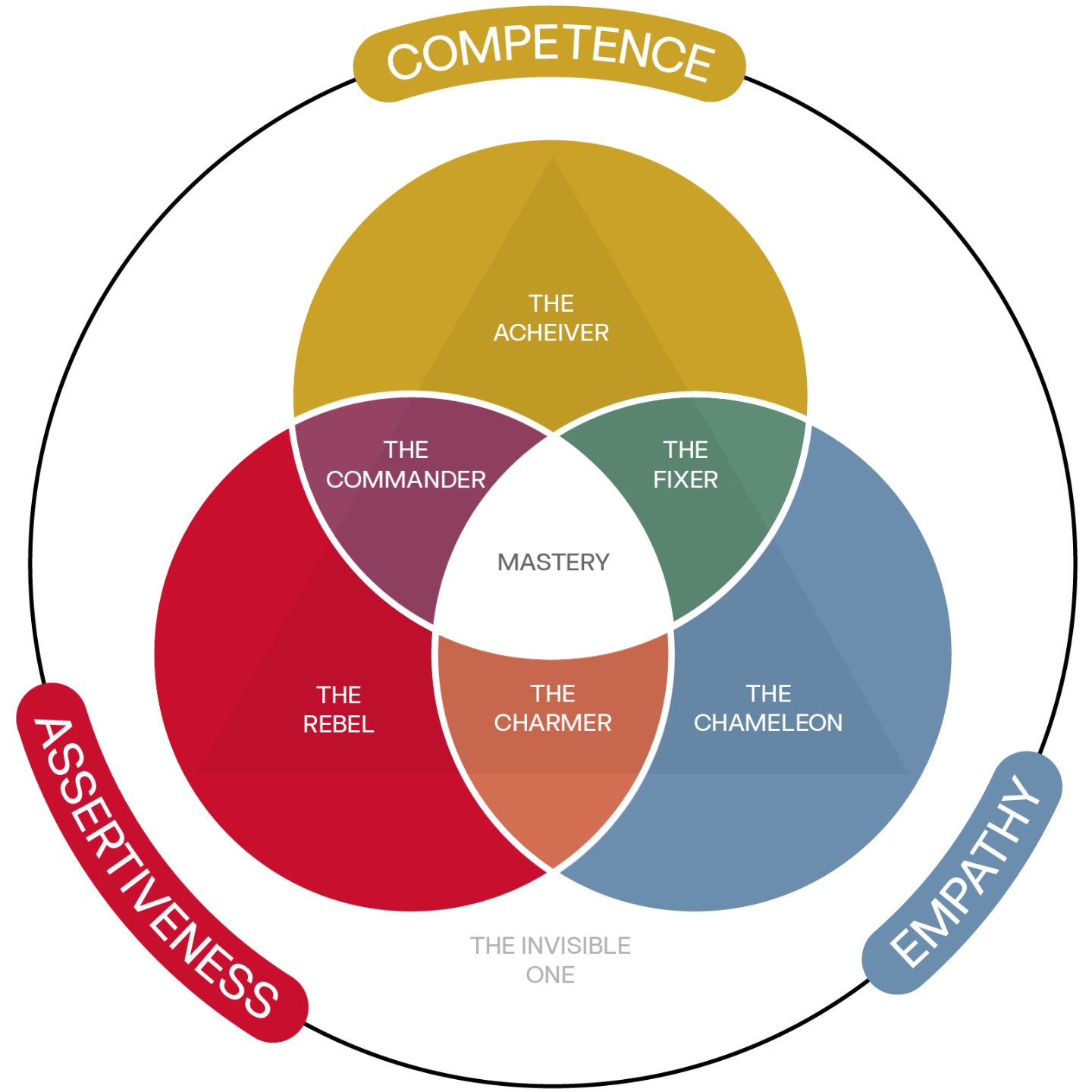
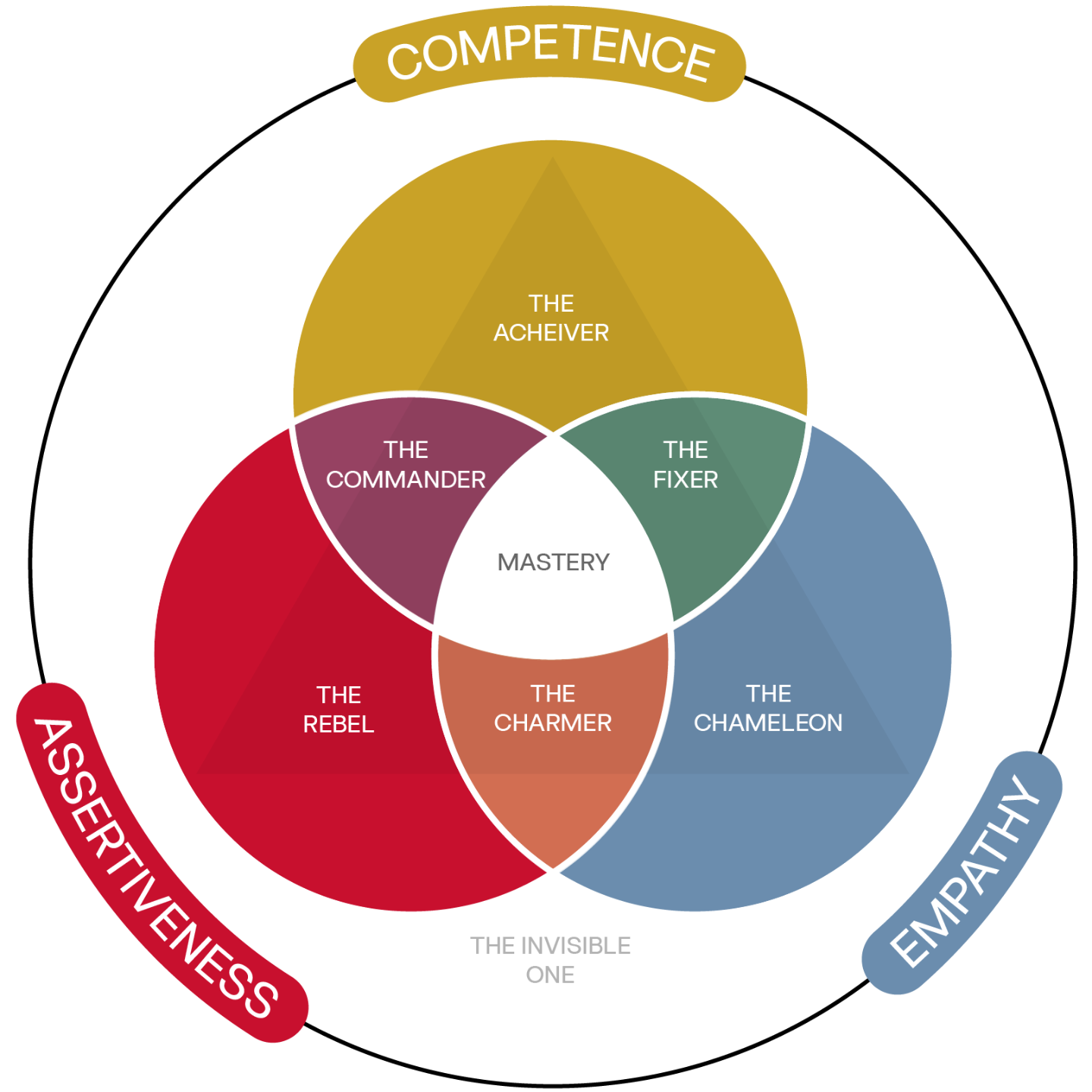
The 7 Patterns Quiz
The 7 patterns—Achiever, Fixer, Chameleon, Charmer, Commander, Rebel, and Invisible One—are behavioral and emotional archetypes that often emerge as coping mechanisms in response to childhood conditioning, particularly within the cultural context of Asian American families.
These patterns are shaped by collectivist values, parenting styles, and the bicultural tension of navigating Asian heritage and Western influences. This guide explores each pattern’s core traits, origins, impact on relationships, and evolution in immigrant families, offering insights into how they can either limit or empower personal growth and connection.
Take the Quiz: Discover Your PatternsThe 7 Patterns: Detailed Profiles
THE 7 PATTERNS: DETAILED PROFILES
 The Achiever
Leads through Excellence | Competence-dominant
The Achiever sets high standards for themselves and focuses on the quality of their output above all else. They believe that merit should speak for itself, that the strongest work, not the loudest voice, should determine who gets ahead.
The Achiever
Leads through Excellence | Competence-dominant
The Achiever sets high standards for themselves and focuses on the quality of their output above all else. They believe that merit should speak for itself, that the strongest work, not the loudest voice, should determine who gets ahead.
Learn more About the Achiever
Achievers would rather redo something themselves than let a version go out that does not meet their standard. They tend to evaluate their own progress through external metrics: results, ratings, feedback from people in authority. They have a hard time celebrating a win because the next thing is already on their mind. If something falls short, they look inward first, assuming the gap was theirs to close.
They often carry the team by doing more than their share of the work, sometimes without others realizing it. They may hold back an opinion in a meeting until they are completely certain, and by then the moment has passed. They tend to lean toward perfectionism, holding themselves to a bar that is rarely, if ever, fully met.
Leadership style
The Achiever leads by example rather than by direction. They believe that leadership should be a meritocracy, that the best ideas and the strongest execution should rise to the top. They are typically the most prepared person in the room, the most thorough in their analysis, and the last to leave a project unfinished.
The challenge for the Achiever is visibility. Because they believe the work should speak for itself, they rarely advocate for their own contributions, or their team's, in the rooms where decisions get made. They may be the strongest performer on the team and still be passed over, because the people making those decisions never heard them claim their seat. Achievers can produce outstanding results and then watch someone else receive the recognition, not because the credit was stolen but because the Achiever never put their hand up.
Communication style
• Precise, thorough, and evidence-based
• Tends to qualify statements and hold back opinions until they feel fully certain
• May convert strong opinions into softer questions to avoid appearing presumptuous
• Often delivers more impact in writing than in live conversation, where they tend to defer
Values and motivations
The Achiever is motivated by the belief that excellence is the highest form of contribution. They value quality, preparation, and earned respect. They take personal responsibility when things fall short and feel deeply uncomfortable claiming credit when things go well. Many Achievers carry a quiet sense of obligation, a feeling that their success needs to justify the investment others made in them. They work hard not just because they want to succeed but because they feel they owe it.
Growth edge
Many Achievers reach a point where they realize that doing excellent work and being recognized for excellent work are two different things. They have spent years believing that if they just delivered more, tried harder, and prepared better, the recognition would eventually come. The growth edge is the realization that visibility is not vanity. It is the missing piece. The Achiever who learns to claim their authority does not become arrogant. They become the leader their work has already proven them to be.
 The Fixer
Leads through Service | Competence and Empathy-dominant
The Fixer orients toward other people's needs before their own. They notice what is missing, what is broken, and what someone is struggling with, and they move to address it, usually before being asked.
The Fixer
Leads through Service | Competence and Empathy-dominant
The Fixer orients toward other people's needs before their own. They notice what is missing, what is broken, and what someone is struggling with, and they move to address it, usually before being asked.
Learn More About the Fixer
Fixers pair emotional sensitivity with real capability. They do not just notice the problem; they solve it. They are the person who stays late to help a colleague finish a project, who remembers that someone on the team is going through a difficult time, who takes on the unglamorous work because it needs doing and nobody else volunteered. They measure their own value through how useful they are to the people around them.
They tend to take on more than their share and struggle to ask for help, because asking feels like burdening others. They may put other people's needs so far ahead of their own that they lose track of what they themselves want or need. When someone asks them what they want, they may genuinely not know, because the question has not been relevant in a long time.
Leadership style
The Fixer leads through reliability and care. They hold teams together by remembering what everyone is going through, stepping in when things fall apart, and doing the work that nobody assigned but everybody needed. Their loyalty runs deep, and the trust they build is rooted in genuine concern for the people around them.
The challenge for the Fixer is self-advocacy. Because they focus on making others successful, they tend to be seen as supportive rather than strategic, the team player who holds things together but not the person who gets put in charge. Fixers can spend years building other people's careers while their own quietly stalls. They may take on responsibilities without pushback, then feel resentment about work that nobody asked them to do. The Fixer's deepest frustration is usually not with other people. It is with themselves, for not speaking up sooner.
Communication style
• Warm, empathetic, and focused on making the other person feel heard
• Tends to soften their own needs and defer to others in group settings
• More likely to phrase a boundary as a question than as a statement
• Excels in one-on-one conversations but may become quieter in larger, more competitive groups
Values and motivations
The Fixer is motivated by the belief that showing up for others is the most meaningful thing a person can do. They value service, loyalty, and being useful. They care deeply about the people they work with and feel a personal sense of failure when someone around them is struggling. What drives them is not recognition but the knowledge that they made a difference. Many Fixers carry the feeling that their place is something they need to continually earn rather than something they inherently deserve.
Growth edge
The Fixer's growth edge is the realization that taking care of themselves is not the opposite of taking care of others. For most of their lives, they have operated as if self-advocacy and empathy are in conflict, as if putting their hand up means abandoning the people who need them. What opens up when the Fixer learns to set boundaries is not coldness. It is sustainability. The Fixer who can receive as well as give becomes the leader others want to follow, not just rely on.
 The Chameleon
Leads through Adaptability | Empathy-dominant
The Chameleon reads any room and adjusts accordingly. They are socially fluent across different groups, cultures, and contexts, finding common ground with almost anyone they encounter.
The Chameleon
Leads through Adaptability | Empathy-dominant
The Chameleon reads any room and adjusts accordingly. They are socially fluent across different groups, cultures, and contexts, finding common ground with almost anyone they encounter.
Learn More About the Chameleon
Chameleons read social dynamics with a precision that most people do not consciously register. They adjust their tone, their energy, even their opinions depending on who they are with. They prioritize putting people together and creating harmony over taking a firm personal position. In a group where two people disagree, the Chameleon is often the one quietly translating between them.
They often prioritize other people's voices so much that they do not vocalize their own conviction. If you ask a Chameleon what they want for dinner, they may genuinely struggle to answer, because they have already scanned what everyone else wants and started optimizing for that. Over time, this can extend well beyond dinner. They may struggle to identify their own preferences, opinions, and boundaries separately from what the room seems to want.
Leadership style
The Chameleon leads through bridge-building. Their main focus is connecting people and creating harmony. They manage across different teams, navigate political complexity, and bring cohesion to groups with very different working styles. They are often the person who quietly resolves tensions that other leaders do not notice, and they do it with a grace that makes it look effortless.
The challenge for the Chameleon is conviction. Because they adapt to the room rather than shape it, teams may find them easy to work with but hard to follow, because nobody is quite sure where they stand. Chameleons can become so skilled at reading what others want that they struggle to find their own voice. Over time, the flexibility that made them valuable can become the thing that makes them forgettable. Someone who does not take a clear position is easy to overlook.
Communication style
• Adjusts tone, vocabulary, and energy to match whoever they are speaking with
• Skilled at asking questions that make others feel understood
• Tends to avoid declarative statements in favor of open-ended, consensus-seeking language
• May say different things to different people, not out of dishonesty but out of an instinct to harmonize
Values and motivations
The Chameleon is motivated by the belief that connection is built through understanding, that if you can see where someone is coming from, you can meet them there. They value harmony, inclusion, and belonging. They take real satisfaction in bridging divides that others cannot cross. What drives them is the desire to belong. What costs them is that the belonging sometimes requires them to set aside who they actually are.
Growth edge
The Chameleon's growth edge is learning that having a point of view does not mean losing connection. They have spent years believing that flexibility and conviction are opposites, that taking a position means alienating someone. What opens up when the Chameleon develops a stable center is that their adaptability becomes a conscious skill rather than an automatic reflex. The Chameleon who knows their own mind and can still read the room becomes the rarest kind of leader: someone who is both rooted and flexible.
 The Charmer
Leads through Connection | Assertiveness and Empathy-dominant
The Charmer draws people in. They bring social confidence and warmth into every interaction, creating a sense of energy and belonging wherever they go.
The Charmer
Leads through Connection | Assertiveness and Empathy-dominant
The Charmer draws people in. They bring social confidence and warmth into every interaction, creating a sense of energy and belonging wherever they go.
Learn More About the Charmer
Charmers combine social confidence with emotional warmth in a way that feels natural and magnetic. They tend to lead with energy and personality rather than with credentials or technical depth. They are the person who walks into a room and shifts the mood, who makes the new hire feel welcome on day one, who turns a tense meeting into a productive conversation by changing the energy.
They create a feeling of ease and openness in groups, often becoming the social center of gravity. But they may feel a gap between how others perceive them (confident, together, effortless) and how they experience themselves privately. The version of themselves that people see is curated, and maintaining that curation takes more effort than anyone realizes.
Leadership style
The Charmer leads through inspiration and social presence. They build team culture effortlessly, often becoming the person who onboards new people, smooths over friction, and keeps morale high. They are skilled at making individuals feel valued, and they bring an enthusiasm that makes people want to be part of whatever they are building. In environments where relationships drive results, the Charmer thrives.
The challenge for the Charmer is depth. Because they lead with warmth and social confidence, they may be enjoyed without being fully trusted for their substance. Charmers often know far more than they let on, but they have learned that being entertaining is safer than being evaluated. Showing depth means dropping the performance, and dropping the performance means risking that what is underneath might not match what is on display. The Charmer's expertise can stay hidden behind their personality, and over time that gap between what they know and what others believe they know can become frustrating.
Communication style
• Engaging, energetic, and socially intuitive
• Skilled at making people feel comfortable and drawing out conversation
• Tends to use humor and storytelling more than data and analysis
• May redirect difficult conversations toward lighter topics to maintain the energy in the room
Values and motivations
The Charmer is motivated by the belief that relationships are everything, that if people feel good around you, doors open. They value connection, warmth, and being appreciated. They take real pride in their ability to create positive energy. What drives them is the desire to be valued. What costs them is the question they rarely ask out loud: would people still value them if they stopped performing?
Growth edge
The Charmer's growth edge is letting their depth be visible alongside their warmth. They have spent years believing that substance and charisma are separate currencies, that you can be liked or respected but not both. What opens up when the Charmer drops the performance is not awkwardness. It is trust. The person underneath the charm is typically more compelling than the act. The Charmer who is both warm and substantive does not lose their magnetism. They ground it.
 The Rebel
Leads through Conviction | Assertiveness-dominant
The Rebel pushes back. They have a strong internal sense of how things should be and an unwillingness to go along with something they disagree with, even when going along would be easier.
The Rebel
Leads through Conviction | Assertiveness-dominant
The Rebel pushes back. They have a strong internal sense of how things should be and an unwillingness to go along with something they disagree with, even when going along would be easier.
Learn More About the Rebel
Rebels operate from a clear sense of what they believe, even when it puts them at odds with the majority. They are comfortable challenging authority, questioning norms, and saying what others are thinking but will not say. They are the person who raises their hand in the all-hands meeting and asks the question that makes the executive on stage pause.
They can be reactive. Sometimes the resistance is principled; sometimes it is automatic, a reflex against being told what to do. They may define themselves more clearly through what they oppose than through what they are building. When someone tries to manage them, they may push back not because the direction is wrong but because being managed feels like being controlled.
Leadership style
The Rebel leads through honesty and willingness to take the unpopular position. They are the person in the room who names the thing everyone else is tiptoeing around. They give permission to question, to push back, and to demand better. In organizations that need to rethink or evolve, the Rebel is often the catalyst. They are not afraid of conflict, and they often turn out to be right.
The challenge for the Rebel is collaboration. Because they lead through opposition, they can be powerful at starting change but struggle to build the structures that sustain it. Teams may admire the Rebel's boldness from a distance while finding them difficult to work with up close. The Rebel's independence can become isolation when it prevents them from building the relationships that turn a good idea into a lasting one. Not every battle the Rebel fights is worth fighting, and the pattern of resistance can become its own kind of rigidity, where saying no becomes the default regardless of whether it serves the situation.
Communication style
• Direct, candid, and unfiltered
• Tends to challenge assumptions and push back on conventional thinking
• Comfortable with conflict and may sometimes create it where it is not needed
• May dismiss feedback that feels like an attempt to manage or control them
Values and motivations
The Rebel is motivated by the belief that integrity means refusing to pretend. They value authenticity, independence, and truth-telling. They care about being real more than being liked, and they take genuine pride in their willingness to stand alone when the situation demands it. What drives them is the desire to protect their sense of self. What costs them is the distance that self-protection can create between them and the people they actually care about.
Growth edge
The Rebel's growth edge is learning to build, not just challenge. They have spent years defining themselves through what they oppose, and that opposition has often been necessary. What opens up when the Rebel learns to connect without compromising is not compliance. It is impact. The Rebel who can be bold and collaborative does not lose their edge. They gain an audience. What changes is not their courage. What changes is that their courage starts to create something that lasts.
 The Commander
Leads through Accountability | Assertiveness and Competence-dominant
The Commander takes charge of the people and projects around them. They focus on keeping everyone on task, maintaining standards, and making sure nothing falls through the cracks.
The Commander
Leads through Accountability | Assertiveness and Competence-dominant
The Commander takes charge of the people and projects around them. They focus on keeping everyone on task, maintaining standards, and making sure nothing falls through the cracks.
Learn More About the Commander
Commanders are comfortable making decisions, giving direction, and correcting course when things drift. They tend to over-function: if something is not getting done to standard, they step in and manage it directly rather than waiting for someone else to figure it out. They are the person who builds the spreadsheet nobody asked for, who follows up on the action items everyone else forgot, who creates systems so that things run properly.
They express care through action: organizing, problem-solving, carrying the operational weight. They are less likely to check in on how someone is feeling and more likely to fix the thing that is causing the stress. They take ownership of outcomes and hold both themselves and others accountable for results. If the team misses a deadline, the Commander takes it personally.
Leadership style
The Commander leads by keeping the machine running. They set clear expectations, follow through on every detail, and create the kind of operational structure that makes ambitious work possible. Unlike the Achiever, who focuses on the quality of their own output, the Commander focuses on everyone else's. They delegate readily, but they also monitor closely. They want to know that the work is being done, done well, and done on time. In a crisis, the Commander is often the person who steps in and creates order.
The challenge for the Commander is control. Because they hold standards so tightly, they may micromanage rather than trust. Their care is real, but it shows up as oversight rather than support. Teams can feel both grateful for the Commander's reliability and constrained by their presence, trusted to execute tasks but not given room to lead themselves. Over time, this creates a cycle: the more the Commander manages, the less the team develops its own judgment, and the more dependent everyone becomes on the Commander to hold things together. The Commander often ends up exhausted, carrying weight they never intended to carry alone.
Communication style
• Direct, structured, and action-oriented
• Tends to lead with solutions rather than open-ended questions
• Comfortable giving critical feedback but may be less comfortable receiving it
• Can come across as intense or impatient when they feel the pace is too slow
Values and motivations
The Commander is motivated by the belief that someone has to hold it together, and they are willing to be that person. They value accountability, reliability, and standards. They care deeply about doing things right and feel a strong sense of duty to the people and projects they are responsible for. What drives them is the conviction that discipline and effort produce results. What costs them is the quiet belief that if they ever stop managing, everything will fall apart.
Growth edge
The Commander's growth edge is learning that trusting others is not the same as lowering the bar. They have spent years believing that quality requires their personal oversight, that the only way to guarantee results is to stay on top of everything. What opens up when the Commander learns to step back is not chaos. It is scale. The Commander who builds people up instead of managing them down does not lose their standards. They multiply them. What changes is not the quality of the work. What changes is that the Commander is no longer the only person responsible for it.
 The Invisible One
Observes through Perception | No dominant dimension
The Invisible One observes more than they reveal. They notice the dynamics others miss, the tensions nobody names, and the details that surface only when someone is paying close enough attention.
The Invisible One
Observes through Perception | No dominant dimension
The Invisible One observes more than they reveal. They notice the dynamics others miss, the tensions nobody names, and the details that surface only when someone is paying close enough attention.
Learn More About the Invisible One
Invisible Ones tend to process internally before speaking, which means their contributions often come late or not at all. They hold strong opinions and real capability but rarely volunteer either without being directly asked. They are the person who knew the answer ten minutes ago but did not say anything because someone else was already talking, or because they were not sure it was their place.
They often describe themselves as someone who "goes with the flow," though privately they may have very clear preferences they simply do not voice. They may have concluded, based on past experience, that speaking up does not change anything, that the room will do what it was going to do regardless of their input. So they watch. And what they see is often more accurate than what anyone else in the room is saying.
Leadership style
The Invisible One is, honestly, not typically leading. That is the pattern. They have opted out of visible leadership, often not because they lack the ability but because they tried once, were overlooked or dismissed, and concluded that the cost of trying again was not worth it. When they do speak, what they say tends to be precisely observed and carefully considered. They are often the person whose one comment reframes the entire conversation. But those moments are rare, because the Invisible One has learned to wait for permission that rarely comes.
The challenge for the Invisible One is presence. Because they hold back, they go unnoticed in the very rooms where their perspective is most needed. They may attend meetings for years without their colleagues understanding what they are capable of. Over time, the pattern reinforces itself: they stay quiet, others stop asking, and the quietness becomes the identity. The Invisible One's deepest frustration is often not that they lack ability. It is that the ability they have sits unused, and they are no longer sure whether the world stopped asking or whether they stopped offering.
Communication style
• Thoughtful, precise, and economical with words
• Tends to listen far more than they speak, especially in group settings
• When they do contribute, their observations tend to be unusually accurate
• May withdraw entirely when a conversation becomes competitive or fast-paced
Values and motivations
The Invisible One is motivated by the belief that there is more to see than most people bother to notice. They value depth, authenticity, and substance over noise. They feel most at home in environments where thoughtfulness is respected rather than speed. What drives them is the desire to understand clearly. What costs them is the distance between seeing clearly and being seen.
Growth edge
The Invisible One's growth edge is choosing to be visible. Not loud. Not performative. Just present. They have spent years watching from the margins, and much of what they have observed is genuinely valuable. What opens up when the Invisible One steps forward is not exposure. It is the realization that the perspective they have been keeping to themselves is the thing the room has been missing. The first act of visibility is the hardest. Everything that follows gets easier.
ADAPTIVE PATTERNS Quiz
TAKE THE QUIZDO YOU EVER FEEL...
Fearful of being an inconvenience to others?
Uncomfortable being praised or recognized?
Compulsive desire to be overly nice or to help others self-sacrificially?
Pressured to change your communication style or even opinions to match others?
Difficulty delegating responsibilities to others?
Stuck in your career or relationships?
Perfectionist Paralysis: unable to start until you know you can do it perfectly?
Compelled to avoid attention and stay in the background?
Do You See Yourself In One or More Patterns?
I know the feeling.
Adaptive patterns are things we learned to do to fit in, to succeed, or even to survive. Over time, these behaviours become habitual, a natural part of the way we speak and act.
At one time or another, I've experienced all of these patterns. And so did many of the hundreds of people I've spoken to and worked with. Over time, this has caused many people to shy away from promotions, giving credit to others that they deserve, or even burning out.
Working with a psychologist, I was able to identify the 7 most common ones that get in our way. These adaptive patterns of behaviour are not personalities or identities and aren't meant to be set in stone. But by becoming aware of them, we can start asking if they are serving us.
Every strength has a shadow, and knowing how to identify the patterns and DECIDING we want to step into them allow us the ability to own them, rather than be owned by them.
(That's me playing the violin when I was 4.)

Disclaimers
Read Disclaimers
1. While the 7 patterns were mapped out with the help of a therapist, they are NOT meant to represent personality types or cultural identities, nor are they an Asian-specific phenomenon.
It’s not meant to say: “these are the different types of Asians”, nor even that they’re different types of people. These patterns can be observed in just about anyone, of any culture or background, and there are many more that can appear. They are simply groupings of behavior and habit trends that were common enough to group into a shorthand, with musings of how they might have been influenced.
The 7 patterns should not be treated as a diagnosis, mental health advice, or even identity for anyone to take on. If you are experiencing any mental health concerns, always speak with a medical professional.
2. Each pattern reflects an adaptive strategy, which may be stemmed from anything from familial conditioning to social adaptations to find belonging.
For Asian Americans, these patterns are frequently influenced by collectivist values like filial piety and high achievement expectations, as well as the cultural clash between Asian collectivism and Western individualism in immigrant families. While these patterns once helped individuals navigate their upbringing, they can now limit growth and connection if left unexamined. Understanding them offers a path to self-awareness, authenticity, and healthier relationships.
3. These patterns are not flaws—they’re adaptive responses to cultural contexts that often place immense pressure on individuals to conform, achieve, and sacrifice.
For Asian Americans, they reflect the tension between the individual and the collective, integrating the BEST of our heritage and culture, while releasing adaptations we might have taken on in the past that might no longer serve us. The core concept is based on "bicultural integration", meaning how we can integrate all parts of who we are, and truly take leadership over our own lives.
Ready to Discover the #1 Pattern Keeping You Stuck?
Discover Your PatternJoin the Big Asian Energy
Email List
Get weekly insights and tools to help you navigate the the imposter syndrome and build your leadership, confidence so you get the recognition you deserve.